Leadership
Just basic responsibilities…
My father always said that “to whom much is given, much is required.” It is thus my belief that with the public investment into my education and training and no less, my own privileges, e.g. male, middle-class background, college-educated parents, that I have a responsibility, as we all do, to use our resources, talents, and platforms to fight against those forces and influences that suppress our fellow citizens and human beings generally. Undergraduates may lend a hand to high school students. Graduate students may lend a hand to undergraduate students and further as a consequence of their stature, expose students on their way to what’s possible in their fields. Professors, principal investigators, and the like all the more have an even greater responsibility to not only their students and universities, but to society as a whole.
America invests hundreds of thousands of dollars and in some cases millions into the ideas and passions and livelihoods of our nation’s scientists. It stands to reason then that they exercise such incredible privilege with humility and with the understanding that their work and their dreams are made possible by the sacrifices of many who never and may never enjoy the benefits, public and personal, of such investment.
When not engaged in research, I invest heavily in learning how to be an effective educator and communicator through my service at Carnegie Mellon’s Eberly Center. I volunteer at every opportunity to guide and mentor high school students at my department’s outreach programs. I serve the graduate student body at GSA Vice President for Finance as well as by sitting on the board for GuSH grants, designed to fund and assist small research projects or small parts of graduate students’ research projects.
Intersectionality
Kimberlé Crenshaw is an American attorney who coined the term “intersectionality.” and basically it describes how the composition of an individual's various identities, particularly those with a history of marginalization, situates a person in society. For example, black trans women experience life in America in a way that's different from how black cis-women or how white trans-women experience life in America. A gay white Mormon experiences life differently in the church than a straight black Mormon. Just one utility of such a framework is that it gives us that much more cause to come together in solidarity. Remember, an injustice anywhere is a threat to justice everywhere; thus, it's incumbent upon all of us to see common cause with one another. Otherwise, we all face the risk of being divvied up at our mutual, collective expense.
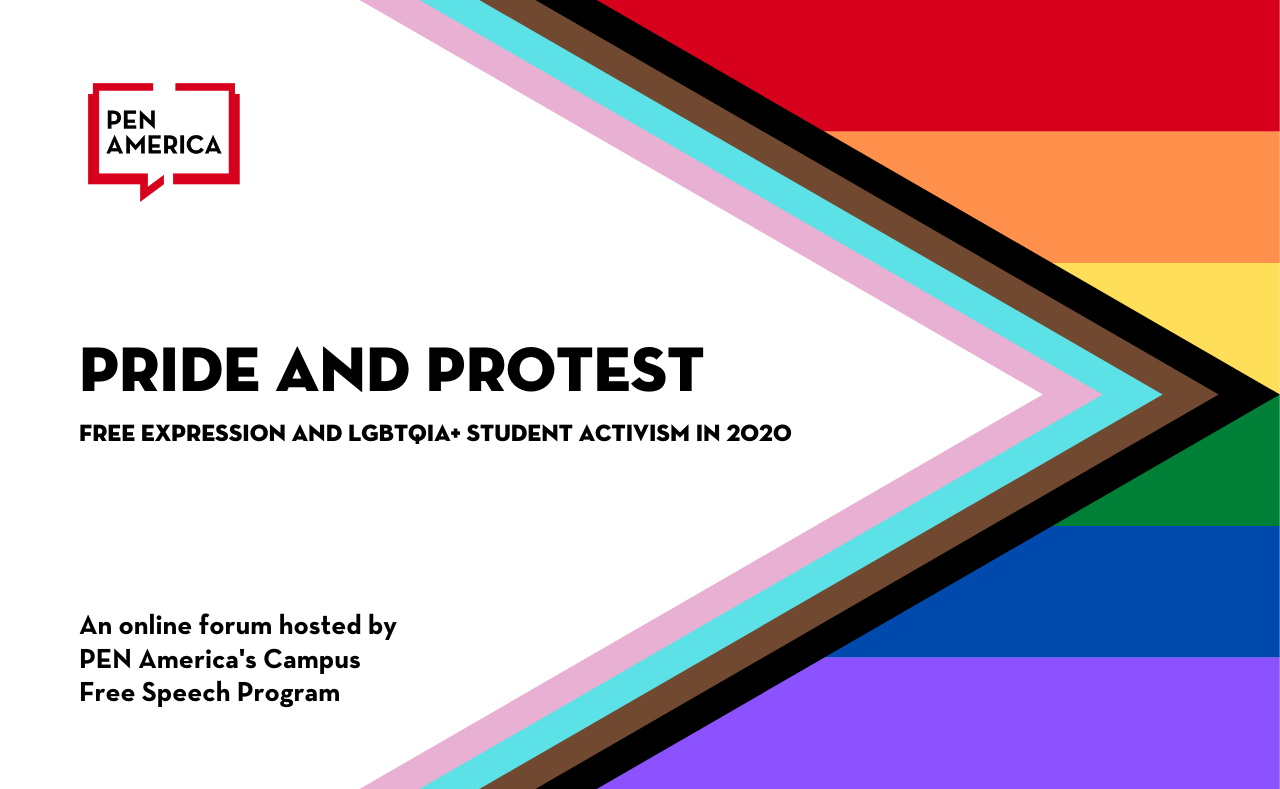
On June 30, 2020 at 3:30p (EST) Nicholas "Niko" Perez, the program coordinator for Campus Free Speech at PEN America will lead and facilitate a discussion among several panelists on a series of topics pertaining to free speech on university campuses, the frontiers of queer theory and activism, what the new priorities of LGBTIQ movement should be, etc.
Please join and follow along. You can find more information here: https://pen.org/event/pride-and-protest/
PEN represents an expansive national community of literary professionals (it used to be an acronym for Poets, Essayists, and Novelists). Some of the most notable writers and members, who hold great respect in my heart, are: Chimamanda Ngozi Adichie, Thomas Mann, Toni Morrison, Salman Rushdie, John Steinbeck, James Baldwin, and Maya Angelou.